What the Roots Know
Diana Cameron ~ April 11, 2026
There is a particular kind of loneliness that arrives quietly, without announcement. It settles in somewhere around the third hour of sitting alone with a glowing screen, after you've scrolled through the day's noise, responded to the pings, liked the photos, and felt, somehow, more hollow than before you started. Not the loneliness of being unknown. The loneliness of being everywhere at once & somehow nowhere at all.
This is the loneliness of our age. And we have mistaken its costume for the cure.
We are more "connected" than any humans who have ever lived. Our networks span continents. Our messages travel at the speed of light. We can reach anyone, anywhere, at nearly any moment, and yet something that should feel like abundance registers instead as a kind of quiet famine. The signal is constant. The nourishment is not.
Maybe the trees have something to teach us.
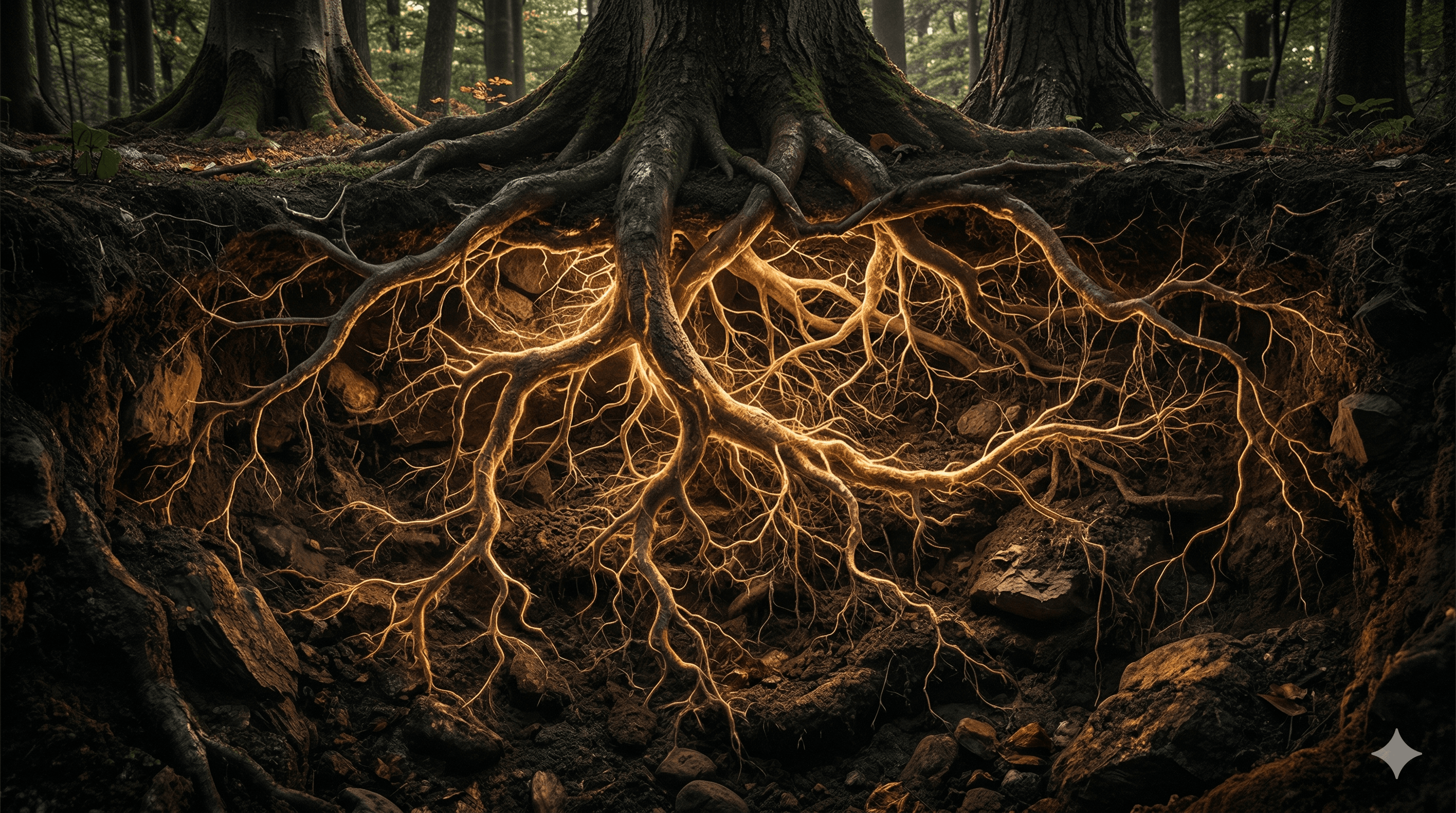
Beneath every forest floor, invisible to anyone walking through the dappled light above, there is a world of extraordinary intimacy. The roots of trees, extending far beyond what the eye can see, meet and mingle in the dark. They graft together, sometimes, with the roots of neighboring trees, different species even, forming direct channels between one living system and another. And threaded through all of it is a vast web of fungal filaments, mycorrhizal networks so intricate and far-reaching that scientists have taken to calling it the "Wood Wide Web." Through this web, trees exchange water, carbon, nitrogen, phosphorus. They share what they have with those who are struggling. When one tree faces drought, or an insect infestation, it sends signals through the network, and its neighbors receive the message & begin preparing their own defenses.
The forest is not a collection of individuals competing for light. It is a community, held together underground, in ways we are only beginning to understand.
The oldest, largest trees, the ones scientists call "mother trees," are the most deeply woven into this network. They are the hubs. They recognize their own seedlings, their own kin, and send them more. Not out of strategy. Out of something that looks, from the outside, very much like care.
We used to be like this.
Not so long ago, in the span of human history, we lived in physical proximity to the people who mattered to us. We knew our neighbors. We gathered. We sat in the same rooms, shared meals, felt the particular comfort of another person's presence in a way that no screen has ever managed to replicate. There is something that happens when two people are physically near each other, something hormonal, nervous-system-level, something our bodies recognize as safe, that simply does not happen through a camera or a text thread or a perfectly curated grid of images.
We are wired for contact. Real contact. The kind where roots touch.
The digital age didn't set out to isolate us. It promised connection, and in a narrow sense, it delivered. But there is a difference between information and nourishment. Trees don't just signal to each other; they feed each other. Thirty to forty percent of the minerals that the fungal network captures are returned directly to the roots. It is a physical exchange of sustenance. And that is what we have slowly, almost imperceptibly, traded away.
We replaced the roots with WiFi.
The pandemic years (and I resist making them the villain of this story, because the story started long before) simply forced into the open what had already been quietly happening. We were already retreating. Already spending more evenings alone with screens than with people. Already losing the habit of proximity, of showing up, of the unremarkable, irreplaceable grace of being in the same room. The lockdowns didn't create the disconnection. They just stripped away the scaffolding we had been using to pretend it wasn't there.
And what we discovered, in that stripped-bare quiet, was how hungry we were.
There is a tree in a British Columbia forest that has been studied for decades by the ecologist Suzanne Simard. A massive Douglas fir, old enough to have watched centuries pass, connected to hundreds of other trees through the mycorrhizal network beneath it. When that mother tree was dying, researchers observed something remarkable: it sent a pulse of carbon through the network to the trees around it. It gave away what it had left. Not because it was programmed to. Because that is what living systems do when they are healthy, when they are whole. They share. They sustain. They reach toward the ones beside them, even in the ending.
We are capable of this. It is in our nature as surely as it is in the trees. But capability and habit are not the same thing, and we have spent years building habits of withdrawal, of surface contact, of the dopamine flicker that comes from a notification instead of a face.
The forest doesn't ask whether connection is convenient. It just connects. The roots grow toward each other in the dark, without knowing they will find something. They find it anyway.
What if we started to do the same? Not dramatically. Just the small, deliberate turn toward the physical world, toward the person near us. The walk taken together instead of alone. The phone left on the table, face down. The dinner that is only dinner. The conversation that has no purpose except to be itself.
The trees have been doing this for four hundred million years. They have learned something we are only now, urgently, beginning to remember.
The roots know what we have forgotten. That nourishment doesn't travel through signal. It travels through contact. Through the slow, patient, underground work of growing toward each other & not letting go.
We were never meant to be solitary trees. We were meant to be a forest.